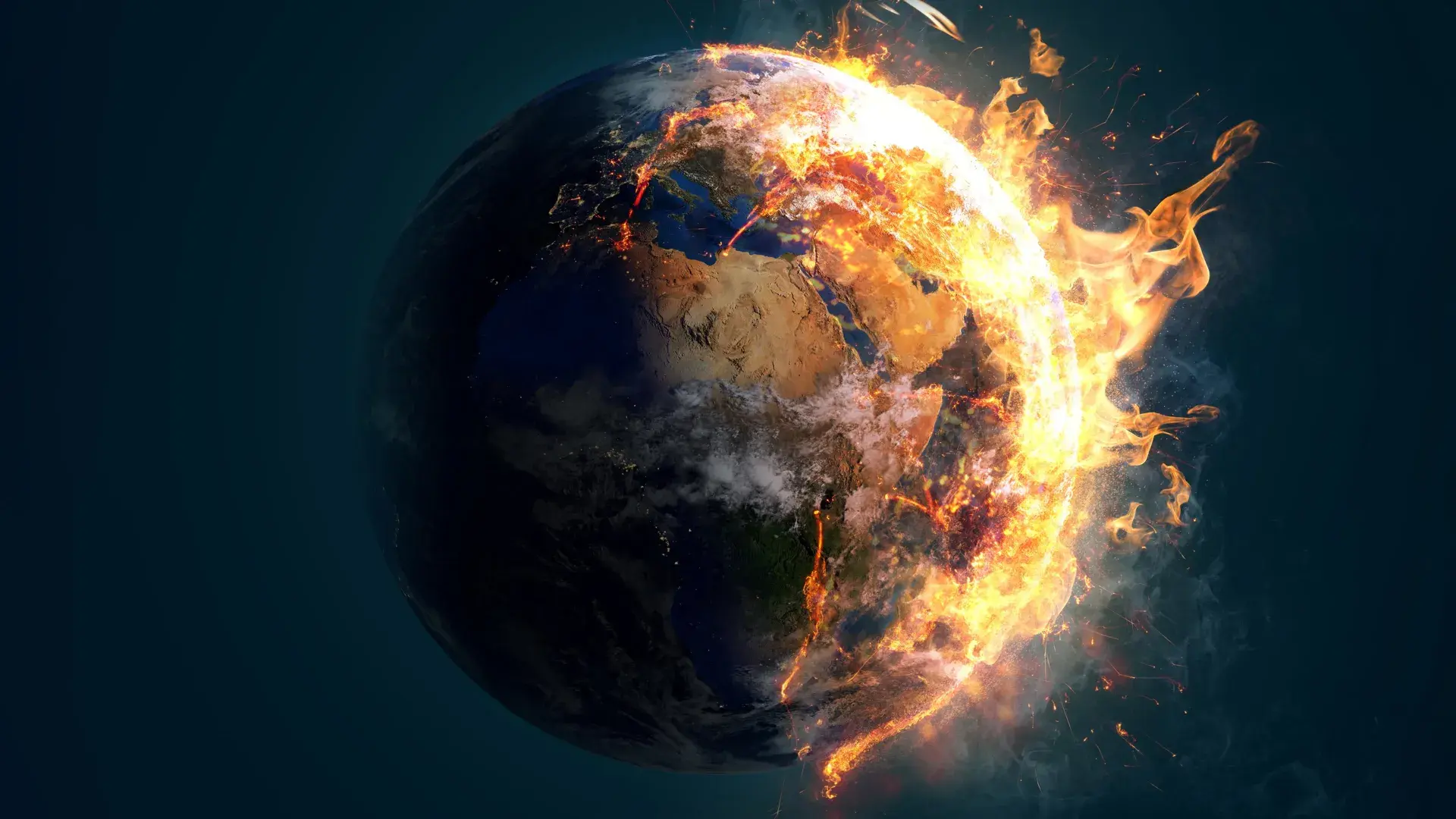
Global warming appears to have shifted into a faster gear. After removing the effects of El Niño, volcanic eruptions, and solar cycles, researchers found that the planet has warmed at roughly 0.35°C per decade over the past ten years, compared with just under 0.2°C per decade from 1970 to 2015. The acceleration, which becomes visible around 2013 to 2015, appeared across five major global temperature datasets with more than 98% statistical certainty.


The thing that doesn’t get called out enough is that many greenhouse gasses have a lag time before they actually start causing heat. CO2 for example takes about 20 years if I recall correctly. So we are seeing the results of what was emitted years ago… not necessarily the current emissions.
Really? I’ve never heard of this, and I’m a climate scientist… Not saying it’s definitely wrong, but a citation would be good.
Edit: Huh, seems it’s true: https://iopscience.iop.org/article/10.1088/1748-9326/10/3/031001 although that is for large pulses of CO2, I don’t know how that translates into a constant stream of emissions…
Well greenhouse gases are often described as a blanket and a blanket doesn’t immediately get warm, it take time. I doubt the trickling effect is much different in lag time than sudden pulses, its just gradually increasing the blanket rather than pulling it all on at once. Its still gonna take time for more solar energy to accumulate by bouncing off the trickling in CO2.
In the book plows, plagues, and petroleum, the author uses several factors of humans history to argue that man made climate change was slowly having an impact much before the industrial revolution, which is the common “starting point” for most people and scientists. Althought not as drastic as this sudden increase in fossil fuel burning, they argue that impacts such as deforestion and burning of cropland in early human settlements had a measureable impact on carbon sinks and carbon releases, still enough to start skewing the natural rate of climate change.
Yeah… realising I was not making a distinction between greenhouse effect (e.g. increased rate of warming), and the result (e.g. actual increased heat content/temperature. I think the rate of warming increase is basically instant, but yes, it takes some time for the temperature levels to catch up.
I don’t know if I was explicitly taught it at uni, buy I have always understood as a climate scientist that GHG emissions started before the industrial revolution (albeit small). I think that’s common knowledge in climate science.
Not true at all. Compare:
“lag time before they actually start causing heat” and
“the timing between an emission and the maximum temperature response is a decade on average”
A “start” and a “maximum” are completely different. IR absorption starts immediately and increases over years to a maximum.
I don’t think that last bit is right, see my other comment to FireRetardant’s reply. I think the increase in warming rate is basically instantaneous (maybe a few months for atmospheric mixing), it’s the peak of temperature/heat that is delayed (agreeing with your 3rd paragraph)
Apologies I should have linked a source in that claim. I only had a rough understanding of it and had read an article on phys.org that mentioned that previously. Arguably still a big concern since we could not be seeing the actual warming done in present day 2026 for another decade or more.