

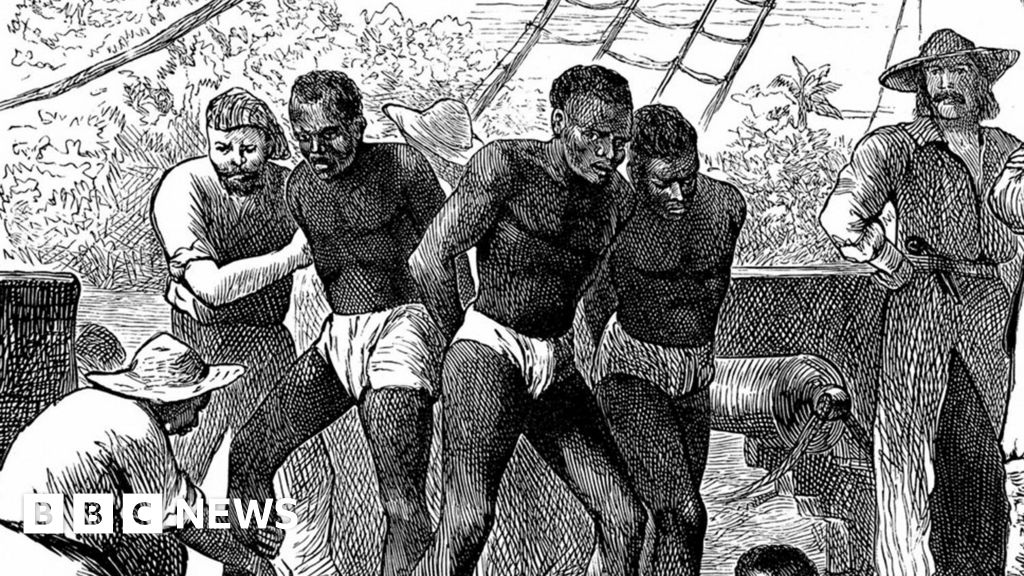
The United Nations General Assembly has voted to recognise the enslavement of Africans during the transatlantic slave trade as “the gravest crime against humanity”, a move advocates hope will pave the way for healing and justice.
The resolution - proposed by Ghana - called for this designation, while also urging UN member states to consider apologising for the slave trade and contributing to a reparations fund. It does not mention a specific amount of money.
The proposal was adopted with 123 votes in favour and three against - the United States, Israel and Argentina.
Countries like the UK have long rejected calls to pay reparations, saying today’s institutions cannot be held responsible for past wrongs.
So it’s pretty definitionally oppression Olympics, but I feel like the slave trade is a decent contender. It lasted centuries; maybe more depending a bunch of history that’s still up in the air. The Holocaust (for example) only went on for a few years.
I’m not sure Ghana has hands as clean as they’re implying, though. The victims of the transatlantic slave trade had to (ahem) leave Africa entirely, and usually it wasn’t the Europeans catching and selling them on their own.
The Holocaust isnt even a notable genocide in history. What makes it special is white people humiliating, brutalising and killing other white people instead of the native African, Arab or Asian. Aime Cesaire makes note of this in Discourse on Colonialism.
I mean, it was hardly the first European genocide.
This is why people don’t like the oppression Olympics. It immediately becomes about who you can make lose them.
What was the first? I wouldn’t count the Armenian genocide as European.
The very first? Uhh, something in prehistory. Maybe neanderthals did them, maybe they were part of how neanderthals went away. There’s a couple genetic near-total replacements in recent British prehistory, for a more concrete example. The mesolithic residents would have been black and blue-eyed.
Rome did a genocide or two, the Byzantines did things to the Bulgars that probably qualify. I’m tempted to say the Mongols, because of the fame, but that’s probably not an example. I don’t know if they targeted any ethnic group selectively, and even in sources from people who hated them it’s pretty clear they were relatively tolerant.
That is the reason so many countries abstained from the vote.
I’m guessing afraid to contradict the US probably fits in there, too.
No because they would be agreeing to having to pay reparations.
It shouldn’t be the average taxpayer in these countries who has to pay for reparations (especially when many were descendants of peasants who were also often exploited in other ways), while the wealthy families who benefited the most evade responsibility, smuggling their blood-earned fortunes to tax havens.
It should, because the collective wealth of most of Europe and the United States is built upon slavery.
Any time people profit from infrastructure and education, which isn’t available in the previously enslaved countries, they are benefiting from the fruits of slavery to this day.
So nothing would be sent to Rio de Janeiro because the infrastructure there was built through slavery, and the same could be said for Luanda.
I am Portuguese. My grandparents and the majority of the Portuguese population didn’t even have basic sanitation or education in the 1970s, despite the fact that our country’s elite were among the greatest, if not the biggest, traffickers in the transatlantic slave trade. The electricity grid only reached their neighborhood in the 80s, more than a decade after the Carnation Revolution of April 25, 1974. Perhaps, our family should receive reparations.
The elite should pay, and the exploited working class must not allow itself to be divided due to petty things like their country of origin. Engaging in any other way is simply falling into yet another “trap” of the universal rent-seeking exploiters, the bourgeoisie. In short, “não se confunda a árvore com a floresta”.