

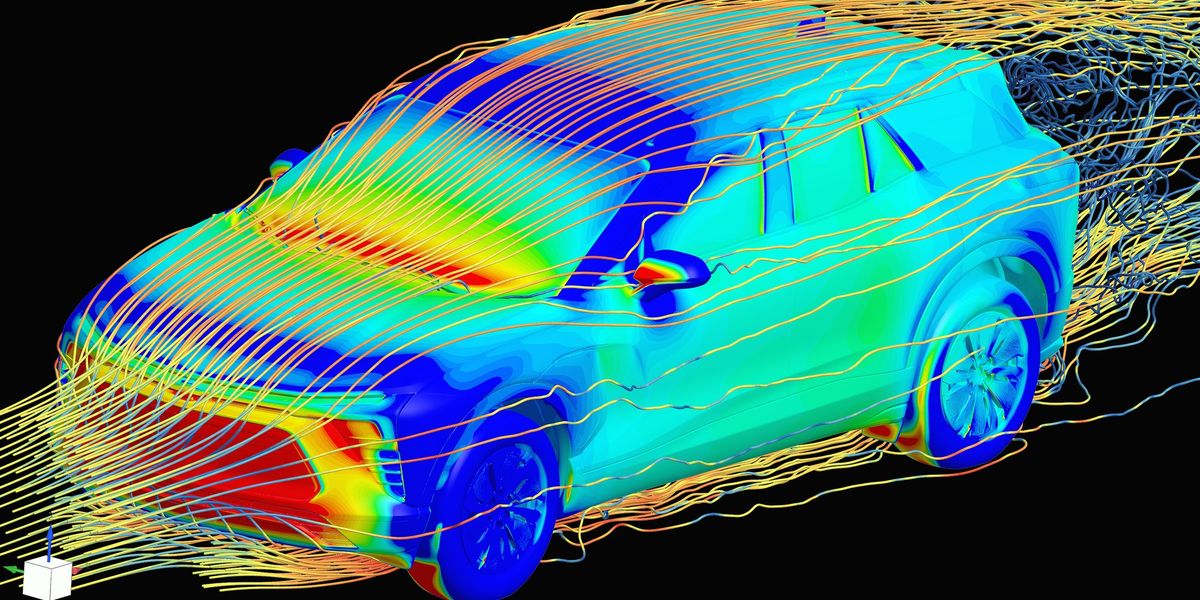
…Previously, a creative design engineer would develop a 3D model of a new car concept. This model would be sent to aerodynamics specialists, who would run physics simulations to determine the coefficient of drag of the proposed car—an important metric for energy efficiency of the vehicle. This simulation phase would take about two weeks, and the aerodynamics engineer would then report the drag coefficient back to the creative designer, possibly with suggested modifications.
Now, GM has trained an in-house large physics model on those simulation results. The AI takes in a 3D car model and outputs a coefficient of drag in a matter of minutes. “We have experts in the aerodynamics and the creative studio now who can sit together and iterate instantly to make decisions [about] our future products,” says Rene Strauss, director of virtual integration engineering at GM…
“What we’re seeing is that actually, these tools are empowering the engineers to be much more efficient,” Tschammer says. “Before, these engineers would spend a lot of time on low added value tasks, whereas now these manual tasks from the past can be automated using these AI models, and the engineers can focus on taking the design decisions at the end of the day. We still need engineers more than ever.”
That’s not too bad if it’s only ever used as a rough guide in the early stages of design, with proper testing done later. But do we trust corporations not to get lazy and pressure their engineers to skip the accurate tests altogether, especially when they can then brag to their investors that AI is replacing expensive engineer time? What would Boeing’s management want to do with this tech?
The regular old FEM based models can be quite misleading and when I had the chance to dig into them some years ago, it made me vaguely anxious. Except that nobody trusts the existing CAE solvers, there’s always a process to verify that actually the structure does what you think it does.
Aerodynamics, at least the coefficient of drag, is actually really good for this because you can’t cheat the air and it’s mostly obvious when you screw it up. Which isn’t true for flutter or the more structural details.
So, yeah, there is that risk, that they’ll get high on their own supply. But thankfully the management already thinks that the current crop of CAE solvers are magical and so the credentialed professional engineers already know how to fight that battle for a lot of the structural details. (The long-suffering assembly line folk who are trying to assemble the airplane properly are, of course, a different matter and have had a lot less leverage)
Although, I’d also propose that there’s a second risk, which is that the current validation process is oriented towards the ways with which the existing FEM models screw you up and it’s likely that when the large physics model screws you up, it won’t be the way FEM models do.
“According to our latest model, if you remove the doors from the aircraft entirely instead of waiting for them to come off midair, you can save about $0.007 of fuel per flight”