

Arthur Besse
cultural reviewer and dabbler in stylistic premonitions
- 65 Posts
- 54 Comments
Joined 5 years ago
Cake day: January 17th, 2022
You are not logged in. If you use a Fediverse account that is able to follow users, you can follow this user.

 3·10 days ago
The new edition, known as TUXEDO OS “Continuous Debian,” replaces the distribution’s traditional Ubuntu foundation with Debian Testing. The change denotes a significant shift for TUXEDO OS, which is developed by German Linux hardware manufacturer TUXEDO Computers.
[…]
Unlike Debian itself, which periodically promotes its Testing branch to Stable, TUXEDO OS will remain permanently based on Debian Testing.
🤔
https://www.debian.org/security/faq#testing currently says:
Q: How is security handled for
testing?A: Security for testing benefits from the security efforts of the entire project for unstable. However, there is a minimum two-day migration delay, and sometimes security fixes can be held up by transitions. The Security Team helps to move along those transitions holding back important security uploads, but this is not always possible and delays may occur. Especially in the months after a new stable release, when many new versions are uploaded to unstable, security fixes for testing may lag behind. If you want to have a secure (and stable) server you are strongly encouraged to stay with stable.
I wonder if TUXEDO Computers plans to be shipping security updates themselves faster than Debian
testingdoes?
LPEs are not RCEs
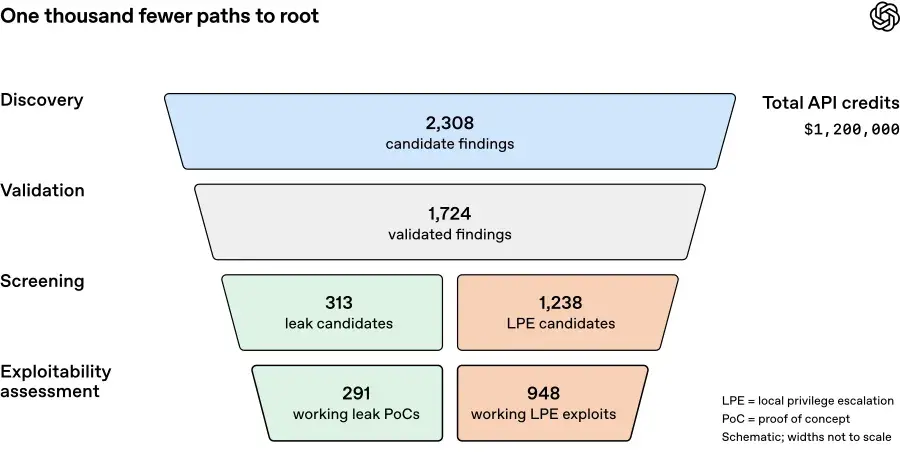
They didn’t say they were, the post is very clear about the the 948 vulns they’re talking about being LPE.
If it’s a bunch of local jvm consoles or vi escapes into shell
if it was that, they wouldn’t be “Linux LPEs”. These are clearly kernel bugs they’re talking about.
And again, stop taking OpenAI at their word about security.
OpenAI is full of shit about a lot of things but I doubt they’re lying about having working exploits for these Linux bugs.
Sure, you can generate a list of places to start testing, but each of those has to be validated, reproduced, documented and understood before it’s confirmed
i guess you didn’t actually read the blog post this article links to? The number in the headline (948) is the number of LPE bugs which they say they validated and reproduced and developed exploits (and patches) for.
what do you mean?
Something else AI’s ruining…
can you explain what you mean by this? are they ruining linux by revealing its bugs at a much faster rate? or ruining the security research field by depriving researchers of the challenge and enjoyment of finding these bugs themselves?
repeating myself from a previous thread: of all the things i hate about LLMs, getting vulnerabilities in important software like linux discovered and fixed is not one of them
(although, as i said elsewhere in this thread, i find it unlikely that openai is actually disclosing all of the bugs they find 😬)
it’s a bit odd how openai’s blog post makes it sound like security bugs in Linux fall in two categories, info leak and local privilege escalation. i would guess that they probably did also ask their model to find some RCEs, but they’re selling those to exploit vendors (or perhaps to intelligence agencies directly?) rather than blogging about fixing them.
 3·16 days ago
https://www.spacejam.com/2021/ is not much different tho
of all the things i hate about LLMs, getting vulnerabilities in important software like linux discovered and fixed is not one of them



 9·1 month ago
Did he really do it tho? Feel like the cops were to willing to jump on the band wagon.
are you kidding? he told the cops 18 years ago (on tape) that he did it, and later he wrote a book about how he did it. to me it doesn’t really feel like the cops and prosecutors were particularly over-eager to do anything here.
Are you arguing tupac wasn’t rich and famous?
No, he was certainly rich (by some definitions) and famous, although at the time of his death his net worth was negative several million (owed to his record label). But did you watch the video I linked?
Are people getting 40 years for a single murder generally?
For first-degree murder, especially for someone with a criminal history as in this case, a sentence of “life without parole” is not uncommon in Nevada.
Hate it when they make examples of people who hurt the rich or famous
Make examples of by… checks notes failing to prosecute anyone for three decades?
This is who Tupac was, btw; not your typical “rich and famous” person. I don’t think there has been a more political rapper with as much mainstream success.
Also fyi the guy who was just convicted of the murder told police (on tape, in 2008!) that he was offered $1M by Sean “Diddy” Combs to do it.


Are Anti-AI Linux distributions practical?
It’s not possible to have a 100% no-LLM-coding-involved Linux distro anymore now that the kernel itself is welcoming LLM-assisted contributions, but it’s still possible to say that everything which the distro produces itself will not use AI.
How can AI commits be responsible?
What Debian means is: by reading what it produces and not just blindly accepting it but having humans review it carefully. The quality of LLM-assisted software is highly variable. Experienced people like Debian and Linux kernel developers are much less likely to publish very bad slop than inexperienced developers who are newly able to make a thing work well enough to ship it.
I am concerned about the extent of Debian’s embrace of LLMs but I still have a lot more confidence in them than most other distros (especially small hardcore-anti-AI distro projects lacking sufficient developer capacity to even keep up with security updates).
I expect we’ll be seeing lots more things like this non-upstreamable-because-AI hardware enablement and distros like Nura (formerly postmarketOS) will either either adopt more nuanced LLM policies or be forked.
I am doubtful about if there will be any serious distros with hard LLM bans in a few years from now. But also, perhaps the bubble will have burst by then, so hosted inference won’t be so cheap and the use of LLMs will probably be quite different.
the primary reason is AI is a thief
This is not the primary reason for most people, I don’t think. I think the fact that it increases complexity while reducing human understanding is the biggest problem; it’s possible (easy even) now to produce mountains of good-enough-by-many-metrics source code which the person doing the prompting has very little comprehension of. The fact that it is also a plagiarism machine is far less of a problem than this. (There are a litany of other problems too of course, several others of which I would also rate as worse than the plagiarism aspect.)



This might be useful for some Linux users who want (but don’t need) to run Microsoft 365 occasionally, but actually relying on this kind of hack is a terrible idea.
Once fully implemented, this will help draw in people into Linux, as many shudder at the thought of switching to the platform because their preferred office suite doesn’t work here.
I certainly hope this doesn’t “help draw in people into Linux”. It’s sad to think about people and organizations switching to Linux on the basis of someone misleading them into thinking that relying on this kind of thing is a good idea because when it breaks it will give them a bad impression and they’ll blame “Linux” instead of Microsoft (or Bottles or whoever told them it was a good idea).
When the lack of a Linux version of a specific proprietary program is the blocker preventing someone from switching to Linux, relying on a workaround which remains unsupported by the proprietary/adversarial software vendor is… a recipe for a bad time.
Even if this mostly works today, it is extremely likely that (either intentionally or inadvertently) Microsoft will break it in the future.
So, although I do see how this can be useful for some people when/while it works, in my opinion Linux and the world at large would be better off if this software didn’t exist. I hope Microsoft breaks it sooner than later!
 5·4 months ago
cross-posting my comment from another thread:
Nice, 🍻 to the people who made this happen.
I couldn’t make it through that interview with the former Google employee, though. A few minor fact checks from before I stopped reading:
I don’t know if you know this, Mike, but the word “boycott” was actually coined in Ireland. Boycott was an individual, an Irish person, and that person actually got boycotted.
Almost correct, except the part about Charles Boycott being an Irish person. (He was unsurprisingly actually English.)
I worked for Google. I worked for Google at a time when… I don’t think they were as evil as they are now. And I worked for Google at a time when they did not use their technology for warfare or for governments. I really enjoyed my time at Google. And I am personally heartbroken at the path that they have taken, and I fully support the boycott of Google in order to support the Palestinian people.
I wonder when it was that this person thinks Google “did not use their technology for warfare or for governments”. I guess they probably think Google only turned evil in 2018, when Project Maven started getting more press? Anyway, such a time never existed; the project which became Google was created by and for US intelligence. https://medium.com/insurge-intelligence/how-the-cia-made-google-e836451a959e
And it’s sickening to think that an organization like Anthropic can come in here, be given tax breaks, being given great publicity, and yet go on to commit the murder of over 160 schoolgirls in Minab, in Iran, but the Irish government says, “Welcome, Anthropic.”
Fuck Anthropic for (among other things) their Department of War contracts, but them taking the blame for the Shajareh Tayyebeh Elementary School massacre is some bullshit: https://www.theguardian.com/news/2026/mar/26/ai-got-the-blame-for-the-iran-school-bombing-the-truth-is-far-more-worrying
But why rewrite programs that existed for decades and have proven their stability and safety? Rewriting them to Rust won’t make them safer, it will just introduce the kind of issues original versions have got fixed long ago.
Of course rewriting them will introduce some new issues, but it will also eliminate classes of bugs from which there are definitely still a great many in old “stable” C code (bugs which are now being discovered and will presumably continue to be discovered at a much faster pace due to LLMs).
The whole project is about abolishing GPL. And Rust is just an excuse.
I don’t think it is just an excuse; I believe that improving security is also a goal… but removing GPL code is clearly also part of their motivation :(
What an absolute shitshow
I’d say the month of June is actually a good time to be breaking and fixing things in a release that is due to come out in (checks notes) October.
ima keep it real with u chief





it’s too bad they went with the K1 instead of the K3 :(
(the K1 is not RVA23)