

A computer shop once laughed in my mom’s face for asking if they’d repair her printer. The accepted practice is to just throw the whole thing out when you want new ink or it stops working.
Eventually she tracked down a guy in another town who fixed printers, and he fixed the printer (a bottle cap was jammed inside, in case you were wondering. He returned the bottle cap).
That was 20 years ago and things aren’t better.
We’re quickly moving towards a Warhammer40k world where “old stuff is better”. Just like digital services become increasingly enshittified, late-stage capitalism incentivises companies to produce things ever more cheaply just to squeeze out some more of that precious shareholder value. Plastics, electronics, garments - everything is so thin nowadays that it will crack, break and tear quickly.
Case in point: here’s a picture of two types of copper wiring.

On the left, you can see the original wiring of a defunct LED light. Further examination showed that the wiring had simply broken in parts of the cable. So I went to the scrapyard and scavenged the wires off an old 1960s lamp plug (that’s the wiring on the right-hand side). These wires had 3-4x the amount of copper strands as compared to modern wires and will not snap easily. I soldered them onto the lamp - now the lamp lives to light another day.
I can only encourage everyone to get a simple soldering iron, some screwdrivers, or a bit of sewing equipment and get to work. You have nothing to lose from tinkering with your stuff (almost*) . If something was broken before, chances are you’d have discarded it anyway, so you can’t break it much more. But the dopamine hit you get when something previously defunct suddenly jumps back to life and serves you for several more years - that’s priceless. Also, fixing your shit is an erect middle finger to the capitalist logic of ever-decreasing product life cycles and the ever-increasing amounts of deliberately produced waste - all that at a time where we’re more painfully aware than ever that resources are finite, and the so-called first world is squandering a lot of them at the expense of everyone else.
So do your bit. It’s thrifty. It’s fun. And it’s the right thing to do.
* Unless you’re dealing with batteries or high voltages, in which case you want to be careful and do your research; house fires are no fun.
Just so you know, the larger gauge wires were to carry more current required by the old halogen bulb and are unnecessarily large for an LED light. A better comparison of how shit is crap these days is that a lot of electronics don’t even use copper wire but instead copper clad aluminum that’s subject to corroding withing 5-10 years of use. But I love to see you repairing things and “upgrading” along the way with thicker gauge wire! Just wanted to point out the larger power consumption of older appliances is often why they have larger gauge wires. There is nothing better for the environment than fixing and reusing what we have rather than replacing !
Just so you know, the larger gauge wires were to carry more current required by the old halogen bulb and are unnecessarily large for an LED light.
Thanks for the insight! Yeah, I could’ve thought about that. Yet, thinner wiring also comes with much poorer wear resilience. Looking at you, headphone and charger cables…
What sort of wear was your LED light getting? I’d not think that the wires would have any sort of flex or give in them on a well designed lamp. Sort of like my house wiring, it’s not like it’s flexing around all that much.
Sure, the wires are larger because they needed to be, but they are still functional, which is what matters.
I’d say one of the issues with repairing things these days is that everything is getting smaller and smaller. Where thick gauge wires were required before, now they use much thinner wire. Where thinner wires were used before, printed circuit boards are often used now. New circuit boards are chock full of miniature surface-mount components which are much more difficult to replace compared to the much larger circuit boards of the olden days. Every step of miniaturisation makes repairs require more skill.
Ugh, that description triggered my PTSD acquired during the latest repairs on a Lenovo Yoga. Tons of printed and taped-on PCB in place of once solid construction.
I guess that’s why nowadays, whenever I need to buy new, I first watch a teardown video to see the insides. If things look finicky and hard to access/repair, I’m not buying. Refuse > repair.
Ribbon cables with sub-millimeter slots to insert them into
Mmmmh! And ribbon cables that you need to manually fold so they’ll fit into the slot - what a great chance to break the sub-millimeter copper wiring inside!
Oh God here’s to hoping my 9ish year old yoga doesn’t give up the ghost anytime soon… At least my Lenovo products have always been rather stout! Only time I have taken it apart was to redo the thermal paste on the cpu cooler and when I did that I realized if something important breaks im probably gonna replace the laptop 😢
the larger gauge wires were to carry more current required by the old halogen bulb and are unnecessarily large for an LED light
To be fair, just because the controlling factor is mechanical strength rather than current capacity doesn’t mean the need for heavier gauge wire isn’t legitimate.
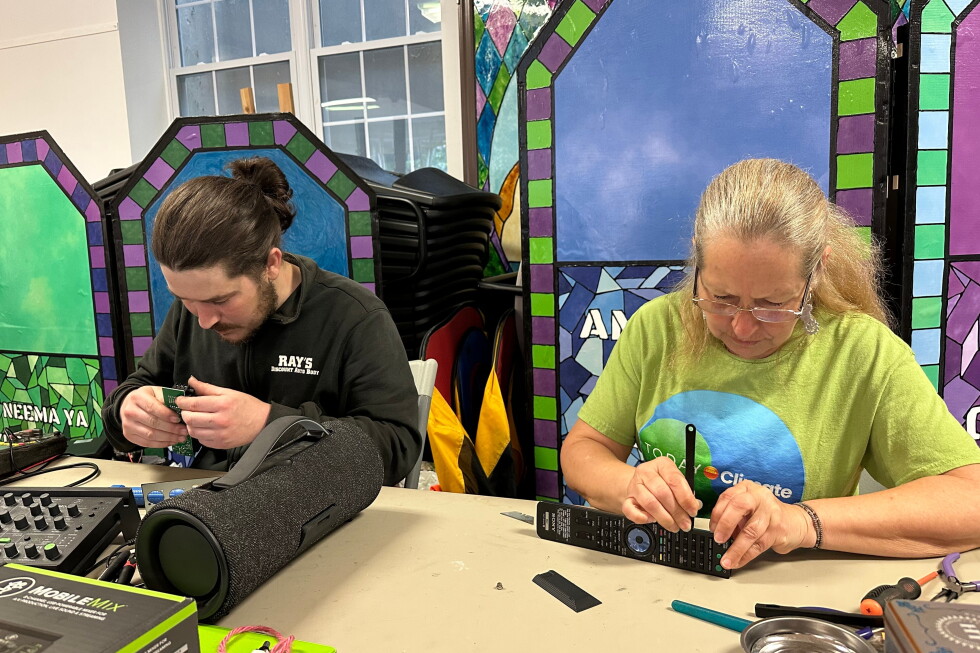
The concept of these repair cafes are great. I’ve volunteered in a couple. But some of the things that people bring in… pair of 10$ flats that the sole has fully fallen of. The damn glue costs more than the shoes. A run of the mill blender from the 90s that just should be retired. Damn t shirts with holes. Please just use the shirt as a rag at this point.
Other things made sense. Laptop hinges, bikes, outdoor power equipment. Holes and buttons in jackets and sweaters.
I would love to do this. I’m great at changing out motorcycle tires and changing out brake pads, but I would love to learn how to solder or even diagnose bad diodes on a board.
It would be a great exchange of knowledge.
Know anyone that’s into gaming? Modding old consoles is a great way to get into diagnosing board problems and fixing the crap PCBs in small electronics is fantastic for learning to solder. Two weeks ago I didn’t know shit about the eldrich slab of charms and runes inside electronics. Last week I successfully tested two power units for a playstation 4 and correctly diagnosed that mine has died due to APU overheating. Took about 2 hours, two videos, and a $15 continuity tester.
Unfortunately, mine’s dead in the water until I find someone who can reball the APU for less than the cost of a new system. In the mean time, I’m doing a tear down and mod on my Xbox 360.
Be the exchange you wish to see!!!
If I can’t fix something…instead of throwing it away, I save it to bludgeon the people responsible for creating something I can’t fix.
You better make sure I’m gone when you go into the bunker. I’m looking for air vents with company logos on them. I’ll have my deluxe HP ready, hung on a leather strap slung around my back.
…when “Squint” & “Cheesecurd” drag you from the depths of Mt. Florida, it’ll be me, “Ink Cartridge Empty” bringing the full weight of my HP2500XLRS down upon thine head!!!
“Anticonsumerist”… kinda a shocking/clickbait way to put it. I wouldn’t call myself an “anticonsumerist” just because I’m cheap, I don’t want to pollute the environment with more tech waste, and I expect the stuff I buy to last. I mean, these people bought it in the first place, right? Maybe just anti-disposable tech?
No they kick you in the shin and make slurs at you the entire time you are trying to fix your stuff. They really want you to feel bad about being a consumer.
It seems these repair cafes are very popular these days. Even my village of 7000 has one.
First I’ve ever heard of it.
Thinking now of the old SNL sketch where John Candy has a repair shop for fixing things most people throw away. Two women come in with a piece of toast they dropped that landed butter-side down on the rug. He decides to freeze it down in some liquid nitrogen and take off the fuzzy side with a belt-sander. Missin’ you, Johnny boy!
I had a VCR that I had to toss, many years ago, because some crappy little plastic gear had lost teeth. Replacing it would’ve cost almost as much as a new VCR. I could see someone with a 3D printer could build one without a lot of effort now.
What does pitching a zipper even mean?
A new euphemism for seeing a hot woman on the bus? “Man she really makes me pitch my zipper!”
Checks out

It’s an old racist term for when English sailors would throw an Asian person overboard. This came from old English doctrine that thought they brought jaundice, and this was the best solution. I’m just messing, this is all BS.
Radical as fuck
I absolutely lament the enshitification of youtube. It used to be easy to find a video on how to fix nearly anything, but that’s bad for the algorithm, because then you turn the screen off and go about fixing the thing, as opposed to watching more videos :(
This reminds me that I just repaired my old Eastern bloc made speakers, a pair of Videoton DCR 2520A. The woofers have out-of-spec surrounds now since the now for real co-op (?) that bought the tools from Videoton during the robber-privatization worn out the tool needed to make the up-to-spec surrounds. They still had the tooling for the midrange speakers, and after some modification I could use some general purpose surrounds from Aliexpress.
I read this as “broken sphincter?” for some reason